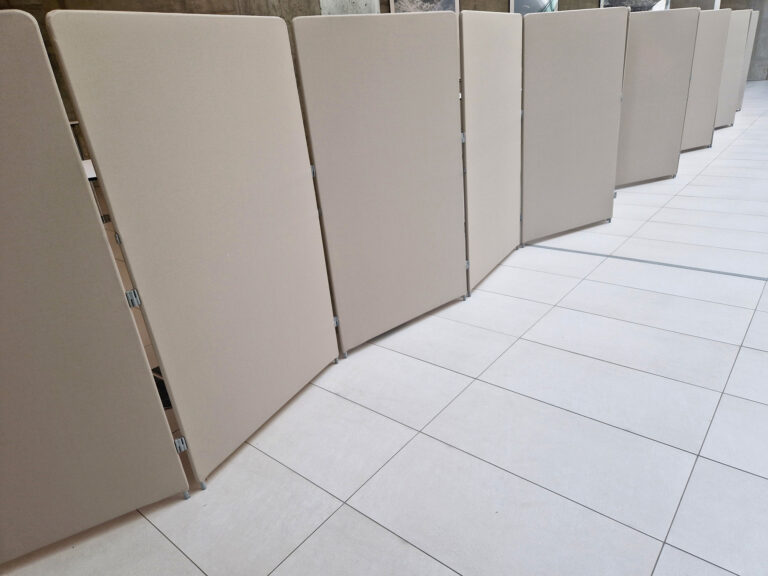
Folding partitions can provide useful sound insulation, but the exact level depends on the system, specification, installation quality and the surrounding room construction. Some folding partitions are designed mainly for visual separation, while others are built with acoustic performance in mind and can help reduce noise transfer between spaces more effectively.
This distinction is important. A folding partition can divide a large room into two usable areas, but that does not automatically mean each side will feel acoustically private. If the wrong system is chosen, sound may still travel through the partition, around the edges, through the ceiling void or via adjoining building elements.
For offices, schools, community halls, clinics and multi-use rooms, acoustic performance should be considered early. The right folding partition can help create more practical, flexible spaces, but expectations need to be realistic. Folding partitions can reduce sound transmission; they do not usually make a room completely soundproof.
What Does Sound Insulation Mean in a Folding Partition?
Sound insulation refers to how well a partition reduces sound passing from one side to the other. In simple terms, it affects how much speech, music, movement or general activity can be heard in the adjoining space.
In flexible rooms, sound insulation is often needed because two activities may happen at the same time. For example, one side of a divided room may be used for a meeting while the other is used for training. A school hall may be split for two classes. A community venue may host a small group session beside a larger gathering.
A folding partition with better acoustic performance helps reduce disruption between those activities. It can make speech less intrusive, improve concentration and give users more confidence that the divided spaces are genuinely usable.
However, sound insulation is not the same as sound absorption. Sound insulation reduces noise travelling between spaces. Sound absorption reduces echo and reverberation within a room. A folding partition may help with one, both or neither depending on its design and the wider room environment.
How Much Sound Reduction Can You Expect?
The amount of sound reduction a folding partition provides varies widely. Lightweight folding partitions may offer only modest sound separation, making them suitable for spaces where privacy is not critical. Higher-quality acoustic folding partitions can provide a more substantial barrier and may be appropriate for meetings, lessons or multi-purpose rooms.
Manufacturers often express acoustic performance using decibel ratings. A higher rating generally indicates better sound reduction, but the figure should be interpreted carefully. Laboratory ratings are measured under controlled conditions. Actual performance on site may be lower if the surrounding building has weak points.
For example, a partition may have a good acoustic rating, but sound could still travel through a suspended ceiling void, gaps around doors, unsealed edges, ventilation routes or lightweight adjoining walls. This is why a folding partition should be specified as part of a complete room design rather than treated as a standalone solution.
In practical terms, a good acoustic folding partition can often make a major difference to comfort and usability. It may reduce normal conversation to a murmur, limit distractions and allow adjoining areas to function more independently. It is unlikely to block all noise completely.
Can Folding Partitions Make a Room Soundproof?
Folding partitions should not usually be described as making a room soundproof. “Soundproof” suggests that no sound will pass through, which is rarely achievable in normal commercial, educational or community buildings without specialist acoustic construction.
A better expectation is sound reduction. A folding partition can reduce sound transfer enough to make the space more usable, but some noise may still be audible. This is particularly true with loud voices, music, impact sounds, children’s activities, sports or public events.
If a room requires very high levels of confidentiality or strict acoustic separation, a more detailed acoustic assessment may be needed. This could apply to therapy rooms, boardrooms, music rooms, exam spaces, healthcare consultation rooms or rooms used for simultaneous teaching.
In those situations, the folding partition is only one part of the solution. Doors, glazing, ceilings, floors, wall junctions and services all need to be considered. A high-performing partition installed into a weak surrounding structure may not deliver the expected result.
What Affects Acoustic Performance?
Several factors affect how much sound insulation a folding partition provides. The main partition construction is important, but so are the details around it.
A folding partition’s acoustic performance can be influenced by panel thickness, panel materials, seals, track design, floor contact, junctions with walls, the quality of installation and the room’s existing construction. The way the partition closes is particularly important. Any small gap can allow sound to pass through.
The building itself also plays a role. In many offices, schools and halls, suspended ceilings can allow sound to travel above partitions if the partition does not continue to a suitable structural or acoustic barrier. Floors, ducts and service penetrations can also create sound paths.
This means acoustic planning should not stop with the partition product. It should consider the full path sound might take between spaces. If the goal is to use both sides of a divided room at the same time, the surrounding details matter.
Why Seals and Tracks Matter
Seals are one of the most important parts of an acoustic folding partition. Even a strong, well-constructed panel will underperform if sound can escape around the edges. Top, bottom and side seals help close gaps and improve separation when the partition is in use.
The track system also matters. A stable, well-installed track helps the partition move properly and close accurately. If panels do not align correctly, seals may not engage as intended. Over time, poor alignment can affect both operation and acoustic performance.
In busy spaces, such as schools or community halls, repeated use can place extra strain on tracks and operating mechanisms. This is why professional installation and periodic maintenance are important. A partition that worked well at installation may lose performance if it becomes misaligned or damaged.
A good acoustic folding partition should feel secure when closed. It should not leave obvious gaps, rattle excessively or feel unstable during normal use.
Are Folding Partitions Suitable for Offices?
Folding partitions can be suitable for offices where flexible room division is needed. They are often used for meeting rooms, training areas, breakout spaces and multi-purpose workspaces. Acoustic performance is particularly important where the partition separates conversations, video calls or focused work.
In an open-plan office, a folding partition can help create a temporary meeting area or divide a larger training room into smaller spaces. This can be useful for businesses that do not want to commit to a fixed layout.
However, the acoustic requirement should match the activity. A simple folding divider may be acceptable for occasional informal separation. A meeting room used for confidential client discussions, management meetings or HR conversations will usually need a better-performing acoustic system.
For a modern office, the finish also matters. The partition should support the look of the workspace and feel like part of the interior rather than an afterthought. In some cases, folding partitions may be combined with glazed or solid fixed sections to create a more complete layout.
Are Folding Partitions Suitable for Schools?
Folding partitions are often used in schools because they allow classrooms, halls and shared spaces to adapt throughout the day. Acoustic performance is especially important in education because pupils need to hear clearly and teachers need to manage noise.
If two classes are taking place on either side of a folding partition, the system needs to reduce disruption enough for both groups to work effectively. This is particularly relevant in primary schools, SEN settings, music spaces, assembly halls and multi-use learning areas.
The Department for Education’s Building Bulletin 93 sets out acoustic performance standards for schools and provides guidance for responsible bodies, designers and contractors. It underlines the importance of acoustic design in teaching and learning environments: https://www.gov.uk/government/publications/bb93-acoustic-design-of-schools-performance-standards
Schools should also consider durability. A folding partition may be opened and closed regularly, used near furniture, and exposed to busy daily movement. Acoustic performance is important, but it should be paired with robust construction and safe operation.
Are Folding Partitions Suitable for Community Halls?
Community halls often need to host a wide range of activities, including exercise classes, children’s groups, meetings, social events, training sessions, rehearsals and local clubs. Folding partitions can help venues divide space more efficiently and support overlapping activities.
Sound insulation matters because different groups may have different noise levels. A quiet meeting next to a lively children’s activity will place more demand on the partition than two low-noise sessions taking place side by side.
A folding partition can make a hall more versatile, but the expected activities should be discussed before choosing a system. If the hall regularly hosts music, performances or sports, higher acoustic expectations may not always be realistic without wider building improvements.
For community venues, the best partition is often one that balances acoustic control, ease of operation, durability and affordability. It should be simple enough for authorised staff or volunteers to use, while still robust enough for regular venue use.
How Do Folding Partitions Compare with Sliding Partitions?
Folding and sliding partitions can both help divide space, but they do so in different ways. Folding partitions fold back in sections, while sliding partitions move along a track and may stack or park to one side. The acoustic performance of either system depends on specification rather than the movement style alone.
A folding partition may be suitable where a straightforward, compact room division is needed. A sliding partition may suit spaces where panels need to move in a particular direction or where the stacking arrangement is important.
In terms of sound insulation, the key questions are whether the system has acoustic construction, how well it seals when closed, and whether the surrounding building supports the desired level of separation.
For projects where space-saving is a major priority, bifold doors may also be worth considering for certain openings, particularly where a clear connection between spaces is needed when the system is open. However, acoustic performance should always be checked against the intended use.
How Do Folding Partitions Compare with Solid Walls?
A fixed solid wall will often provide stronger acoustic separation than a folding partition, particularly when constructed as part of a complete acoustic build-up. However, a fixed wall removes flexibility. Once the room is divided, it stays divided unless further building work is carried out.
Folding partitions are different because they allow the space to change. They may not match a high-performing permanent wall acoustically, but they offer the practical benefit of opening and closing when required.
This trade-off is important. In a building where two spaces must remain separate all the time, a fixed wall may be the better choice. In a building where one large room sometimes needs to become two smaller rooms, a folding partition may provide the better overall solution.
The right decision depends on whether flexibility or maximum separation matters more.
Can Finishes Affect Acoustic Performance?
The finish of a folding partition can affect the way the room feels, but the main acoustic performance usually comes from the construction of the panels and seals. That said, some surface finishes may influence sound within the room, especially if they have absorbent or reflective qualities.
Hard, smooth finishes can look clean and professional, but they may contribute to a more reflective acoustic environment if the rest of the room also has hard surfaces. Softer finishes or additional acoustic treatments may help reduce echo inside the space.
For interiors where appearance and warmth are important, wooden partition systems may provide useful design inspiration. Timber and timber-effect finishes can create a more welcoming feel in halls, offices, community venues and learning spaces.
However, appearance should not be allowed to override acoustic requirements. If sound insulation is important, the partition must be specified for acoustic performance first, then finished in a way that suits the interior.
How Can You Improve the Result on Site?
Good acoustic performance depends on planning, specification and installation. A folding partition should be matched to the room’s real use, not chosen solely from a brochure or price list.
To improve the result, consider the level of privacy needed, the type of noise expected, how often both spaces will be used at the same time, the ceiling construction, door details, wall junctions and whether other acoustic treatments are required.
It is also worth thinking about behaviour and room management. Even a good partition cannot overcome every issue if one side of the room is hosting a loud activity while the other is being used for quiet work. Scheduling and zoning still matter.
Maintenance also helps preserve performance. Tracks, seals and closing mechanisms should be kept in good condition so the partition continues to close correctly.
What Should You Ask Before Choosing an Acoustic Folding Partition?
Before choosing a folding partition, ask what problem the partition needs to solve. Is the goal to provide occasional privacy, reduce general noise, allow simultaneous teaching, support confidential meetings or simply create a visual divide?
The answer will shape the required specification. A staff training room may need moderate acoustic separation. A therapy room may require a more carefully controlled environment. A school hall may need durability and acoustic performance combined.
It is also useful to ask who will operate the partition, how often it will be used, where the panels will stack, how the system meets existing walls and ceilings, and whether future room use may change.
A professional survey can help identify practical issues before installation, especially in older buildings or rooms with suspended ceilings, uneven floors or complex service routes.
Frequently Asked Questions
Do folding partitions block all sound?
No, folding partitions do not usually block all sound. They can reduce sound transfer significantly when specified and installed correctly, but some noise may still pass through or around the room structure.
Are acoustic folding partitions suitable for classrooms?
Yes, acoustic folding partitions can be suitable for classrooms and school halls, particularly where spaces need to be divided for simultaneous teaching or activities. The specification should reflect educational acoustic requirements and daily use.
Why does sound still travel after a partition is installed?
Sound may travel through gaps, ceiling voids, doors, floors, ventilation routes or adjoining walls. The partition may be performing correctly, but the surrounding building can still allow sound to pass between spaces.
Final Thoughts
Folding partitions can provide valuable sound insulation, but the level of performance depends on the system and the building around it. A light-duty folding divider may offer basic separation, while an acoustic folding partition can make a room far more practical for meetings, lessons and multi-use activities.
The most important point is to set realistic expectations. Folding partitions reduce sound; they do not usually create a fully soundproof room. For the best results, the partition, seals, tracks, ceiling, doors and surrounding construction should all be considered together.
When specified properly, folding partitions can offer an effective balance of flexibility, acoustic control and practical space division.
For advice on folding partitions, acoustic requirements and flexible room layouts, contact A-Door Additions to discuss your project.
Phone: 01373 454577
Email: info@a-dooradditions.co.uk
Find out more: https://buildingadditions.co.uk/