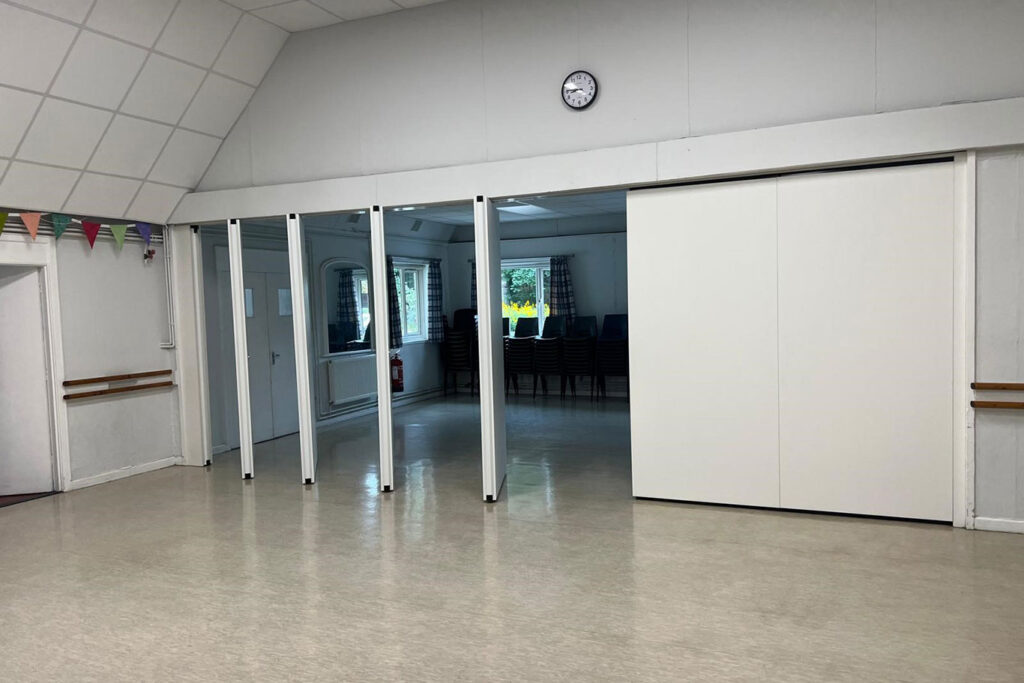
Community halls, leisure centres and public buildings are expected to serve a wide variety of purposes. A single venue may need to host meetings, exercise classes, social events, training sessions and private functions all within the same week. Managing these different activities can be challenging when space is limited. Public hall partition systems provide a practical and highly effective solution.
By allowing large open areas to be divided into smaller, functional rooms, public hall partition systems help venues make the most of their available space. They offer flexibility, improved acoustics and the ability to run multiple activities at the same time without disruption.
The Challenge Facing Modern Community Venues
Most public halls were originally designed as large, open spaces. While this layout works well for big events, it is not always suitable for everyday use. Community groups and local organisations often require smaller, quieter rooms for their activities.
Without an effective way to divide space, venues can struggle with:
Noise clashes between different groups
Underused areas during quieter periods
Limited options for private meetings
Reduced potential for simultaneous bookings
Inefficient use of heating and lighting
Creating Truly Multi-Use Spaces
Flexibility is essential for any community building. Public hall partition systems allow managers to adapt layouts quickly and easily to suit different events and user requirements.
With the right partitioning system, a hall can be converted into:
Separate rooms for classes and clubs
Smaller meeting spaces
Private function areas
Exhibition zones
Training rooms
Quiet areas for community services
This adaptability increases the usefulness of the venue and makes it more attractive to a wider range of users.
Improved Acoustics and Privacy
One of the biggest benefits of public hall partition systems is their ability to control sound. When several activities take place in the same building, noise can quickly become a major issue.
High-quality partitions provide strong acoustic separation, helping to:
Reduce sound transfer between rooms
Create calmer environments for meetings
Improve concentration for classes and training
Allow music or exercise sessions to run without disturbing others
Maintain privacy for sensitive discussions
Good acoustic performance is often the difference between a venue that struggles with multiple bookings and one that operates smoothly throughout the day.
Increasing Revenue Opportunities
For many community venues, generating income from room hire is essential. Public hall partition systems make it possible to host several groups at once, significantly increasing booking potential.
Instead of hiring out one large hall at a time, venues can:
Offer multiple smaller rooms
Cater for different budgets
Accommodate more users per day
Run parallel events
Provide tailored spaces for local organisations
This improved flexibility can have a direct and positive impact on the financial sustainability of public buildings.
Quick and Cost-Effective Installation
Unlike permanent building alterations, public hall partition systems can be installed quickly with minimal disruption. This is particularly important for busy venues that need to remain operational.
Professional installation offers:
Fast project timescales
Minimal mess and building work
Little or no downtime
Reduced overall costs
The ability to upgrade existing spaces
For many organisations, partitioning represents a far more affordable option than constructing new rooms or extensions.
Long-Term Flexibility
Community needs change over time. A layout that works today may need to be adjusted in the future as user groups evolve. Public hall partition systems provide long-term adaptability.
Partitions can be:
Reconfigured into new layouts
Expanded to create additional rooms
Updated with doors or glazed panels
Modified to suit different activities
This future-proof approach ensures that public venues remain useful and relevant for many years to come.
Choosing the Right Public Hall Partition Systems
Every building is different, and selecting the correct partitioning solution is essential. Factors such as room size, acoustic requirements and frequency of use must all be carefully considered.
Working with an experienced specialist ensures that the chosen system delivers the right balance of performance, durability and ease of use.
At A-Door Additions, we design and install bespoke public hall partition systems for community venues nationwide. Our team provides expert guidance from initial planning through to professional installation.
Conclusion
Public buildings must be able to serve many different purposes, often at the same time. Public hall partition systems offer a simple, effective way to transform large open spaces into practical, flexible and revenue-generating environments.
By improving acoustics, increasing privacy and enabling multi-use layouts, partitions help community venues operate more efficiently and meet the needs of their users.
For professional advice on public hall partition systems tailored to your venue, contact A‑Door Additions today.
Phone: 01373 454577
Email: info@a-dooradditions.co.uk
Frequently Asked Questions
Q1: Can public hall partition systems be moved after installation?
A1: Yes. Most systems are designed to be reconfigured, allowing layouts to be changed as your venue requirements evolve.
Q2: Do partitions provide good sound insulation?
A2: High-quality systems offer excellent acoustic separation, helping different activities to run side by side without disturbance.
Q3: How long does installation usually take?
A3: Installation times depend on the size of the project, but most partitions can be fitted far more quickly than traditional building works.